
The more, not the most
Who are you? Whose are you? Whose might you mistakenly become?

I spent this week at the Jesuit Retreat Center in Los Altos, California, serving as a spiritual director on the silent retreat for this year’s California cohort of the Jesuit Volunteer Corps.
The week was a boon and a balm.
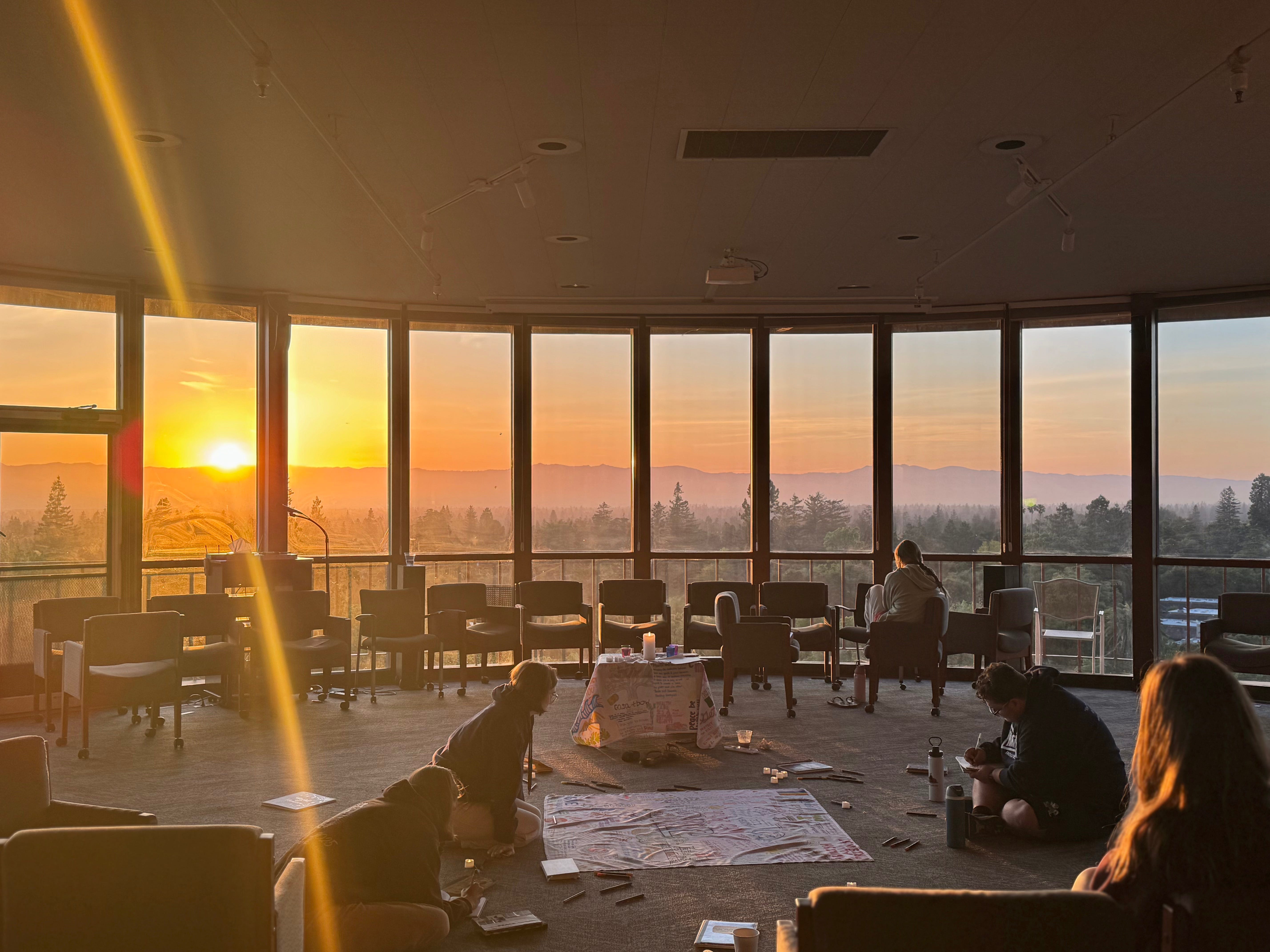
The young people I accompanied embody hope. I can’t tell you how moved I am by their work and their witness. I’m walking away from this week convicted anew that Ignatian spirituality and its creative unleashing in the world is the work of my life.
On the final day of the retreat, I was invited to give a talk on the magis, an oft-deployed but easily warped Ignatian ideal my own soul has chased around over the years. I offer a draft of that talk here, preserved in the cadence and form of spoken delivery (with all its attendant nonsensical punctuation and repetition !) rather than adapting it for the page.
Friends, who here has heard of the magis?
Great. So most folks here are familiar with this Ignatian value. The magis refers to the more: a desire to do more, to be more, that’s grounded in gratitude for all we’ve been given. Any explanation of the magis is usually followed with an immediate explanation of what it is not: it is not doing more for ourselves, it is not doing more so that we can exhaust the farthest reaches of capitalism, and most helpfully for me, it is not doing the most.
The magis demands that we ask ourselves where we might love more, what more we might do for one another, what more we might do for God.
The more, not the most.
The more, not the most.
A thousand years ago, in 2017, I was on retreat at Loyola Chicago. Any Loyola Chicago folks here? You have a gorgeous campus on the shores of Lake Michigan. I fell asleep those nights on retreat with my room’s windows open listening to the lake outside. It was June, so I could do this without dying. At The University of Scranton, we had coal mines and dive bars in the living rooms of houses — which are their own kind of beautiful.
But those days at Loyola Chicago, the awe I felt before the waterfront opened my soul to reflection, which is why I can still reflect back to you almost verbatim a talk given there by a Jesuit named Tim O’Brien.
Before I plagiarize his thoughts, know that good ministry is shared, but the best ministry is stolen. That I share them here is a testament to how much his words meant to me.
I will now launch into a 75-minute reading of Father O’Brien’s talk from 2017.
Just kidding.
His talk was framed with three questions that I’ve carried with me in the decade since, and that continue to help me understand how I might embrace the magis in my own life. These three questions were:
Who are you?
Whose are you?
And whose might you mistakenly become?
Who are you, whose are you, and whose might you mistakenly become?
Those questions, especially the last one, are sort of threatening. And I like that about them.
Sometimes I think I’m living the magis, all for the greater glory of God, when instead I’m living from my ego, all for the greater glory of Marissa. Returning to these questions across seasons of my life has offered a helpful corrective when I realize I’m pursuing my ambition in a vacuum, when I’m on a vertical ascent to nowhere.
I have a story for each of these three questions — who am I, whose am I, whose might I mistakenly become. I imagine if you were to trace the arc of the magis in your own life, you might too.
So: who am I?
The summer after I graduated from college, I led a Campus Ministry immersion trip to Quito, Ecuador, to serve at The Center for Working Families. My selection as a leader in this popular Campus Ministry program was a highlight of my senior year. I loved the work and the people so much, I didn’t mind that I spent almost every Thursday of my senior year in reflection meetings from 9–11 PM on Thursdays. The Mumford and Sons closing reflection song of a meeting would still be ringing in my ears as I tumbled into the bar blasting Ke$ha. I invoke Ke$ha here not as an attempt at coolness, but as a chronological marker. Thank you for honoring my millennial cringe.
Anyway —
I arrived in Quito with my binder full of reflection prompts and prayers and community builders and all my hopes and dreams for this trip and this group and, if I’m being honest, my life after Scranton, and almost immediately upon getting there, I got horribly, horribly sick.
I was not able to join our delegation in their service or sightseeing. I wept to the onsite doctor about how my parents didn’t have passports and couldn’t afford to repatriate my remains because I’m a little dramatic and hadn’t yet been diagnosed with the altitude sickness I was suffering from.
In any case, I was sick, and confined to the retreat center where we were staying, and I spent a lot of time in the library.
I was disappointed and embarrassed and, more deeply, I was beginning to process fears I hadn’t yet named about life after graduation. I had done really well in college — but I had also been on my own financially since my senior year of high school, and I couldn’t move home after graduating, and I couldn’t afford grad school yet. I was moving to Boston to be with my boyfriend and work as a nanny, and I was terrified I was going to leave behind all the good things Scranton had sown within me: a commitment to the marginalized, a spiritual depth, a desire for rich community.
What if that’s just who I was in college? What if the sense of aliveness I felt was isolated to those years?
Would I just fade into a lukewarm mediocrity in adulthood and never feel close to God or myself again?
If you need to tune out here, I’ll spoil the story: the answer is no, and the proof is that all these years later, I still make my way to spaces like this one because I still prioritize spending my time among people wrestling with questions about God and the world like we all have these last few days.
But I didn’t know that then.
All I knew was that I was desperate for some sign, some oracle I could trust who could reassure me that I wasn’t going to lose myself on the other side of that summer.
I pulled a random book off the library shelf, The Inner Voice of Love by Henri Nouwen, and I flopped open to a passage entitled “Come Home.” Please indulge me here and allow me to read it – it’s very short.
There are two realities to which you must cling.
First, God has promised that you will receive the love you have been searching for. And second, God is faithful to that promise.
So stop wandering around. Instead, come home and trust that God will bring you what you need.
Your whole life you have been running about, seeking the love you desire. Now it is time to end that search. Trust that God will give you that all-fulfilling Love and will give it in a human way. Before you die, God will offer you the deepest satisfaction you can desire. Just stop running and start trusting and receiving.
Home is where you are truly safe. It is where you can receive what you desire. You need human hands to hold you there so you don't run away again. But when you come home and stay home, you will find the love that will bring rest to your heart.
Many of my friends after graduation were off doing years of service or attending graduate school or chasing sexy jobs in big cities, and I felt lost and alone. Perhaps you’ve felt this way already. Maybe you’re feeling it now as you approach the threshold of this year’s end. Maybe your plans are totally set and you feel absolutely confident in them, but you’re not sure how to carry forward what JVC has stirred within you.
Maybe you’re asking, at this crossroads: who are you?
As Henri Nouwen wrote in that passage, “Just stop running and start trusting and receiving.”
I thought the only way for me to make good on the dreams I had for myself was to immediately take off in the rat race, when instead, that next year demanded something humbler from me. I needed to stay still, to make a home within myself, and to trust it.
So, who are you? What home do you trust within yourself?
When I think about this, I like to imagine a kaleidoscope. If I understand correctly how a kaleidoscope works — and I might not, I studied theology — you have colorful beads, and mirrors, and light, and as you twist the kaleidoscope around, the colors remain the same no matter how you twist or turn the scope, but they take on a different shape depending on how the light hits them.
Kaleidoscopes, are you with me?
Imagine that the colors within the kaleidoscope — the beads — are the elements of your personality that endure no matter where you are or who you’re with. You’re sensitive, you’re introverted, you’re good at math, you’re quick with a joke. The beads, the colors, are the pieces that make you you. They will always be there, no matter what.
But depending on how the light hits them, perhaps how you show up in the world will take a different shape.
The colors are static; how they reflect is dynamic.
So who are you? What are your colors?
When it comes to the magis, when we know ourselves, when we trust ourselves, when we ask unflinchingly, who are you, we’re better able to know whether we’re making a decision from our egos, or to impress someone, or out of convenience, or because this is the easiest way to show up in a world that would rather discard people than honor their humanity — or if we’re making a decision from the truth of who we have been created to be.
To embrace the magis, you need to know your colors, and you need to know how you want them to reflect light back into the world.
Who are you?
Second question: whose are you?
We’re going to get a little deeper here, friends.
I spent most of my adulthood life unsure about whether I wanted to become a parent. Growing up, my dreams for myself always included being a mother to my own children. But once I finished graduate school and began my career, my life felt very full. As friends of mine began having kids, I didn’t feel the same desire they did to start a family. I have the extraordinary honor of serving as godmother to three young boys, all from different corners of my life, so I had and have a privileged intimacy with shaping young lives that I take seriously. I wasn’t pursuing motherhood with any urgency. And my work made me feel alive. My nights and weekends were spent talking about God with young people. I liked my life.
So I began to explore the possibility that maybe motherhood wasn’t for me, and I imagined what a full, free, vibrant childless calling might look like.
Some of this was very genuine. I really am so blessed to have found work that doesn’t feel boring or mercenary, that allows me to write and travel and meet exciting people like you. My days continue to brim with possibility and fulfillment.
Some of this was also… a bit of mission drift.
Much of my reticence around motherhood came from taking inventory of the ease with which I lived my life and fearing the loss of slowness and spontaneity that childlessness allows: sleeping in on a Sunday morning, languid hangovers, untethered errand running, working late, feeding my vanity with frivolous purchases, last-minute workout classes, travel. I liked my life. I liked my body. I liked my disposable income, my leisure, my lack of accountability. I liked the hollow sense of superiority I felt in showboating a life that was full without children, that I was somehow better, more evolved for not desiring parenthood in the ways other folks did and do.
So, believe me when I tell you my pregnancy was wildly unexpected.
I had just moved to California from Massachusetts to take on a new job where I was the first lay woman in the role. I was living in a university residence hall. I didn’t have friends in California yet. I didn’t have a doctor. And most deeply, my spouse and I were considering divorce: we had been separated and were fumbling around figuring out whether our futures involved each other.
Becoming pregnant — unplanned and deeply disorienting, though fully cushioned by enormous privilege — humbled me in ways I would once have found nightmarish.
Becoming more fragile and dependent on others, having to decline invitations to very exciting international work trips scheduled precariously close to my due date, relinquishing all the self-centered and ego-serving elements of my life I mentioned before — all of this introduced me to what Ignatian spirituality calls downward mobility: the understanding that the Gospel doesn’t call us to be successful or comfortable, but faithful.
My pregnancy and parenthood demanded from me a reordering of my life that I thought I was incapable of. They required a discipleship I had spent my entire life avoiding because it was easier being kind of a vain asshole than it was to grow up and give myself over for the goodness of another.
Parenthood has introduced me to a love I wouldn’t have otherwise encountered, a reordering love. Perhaps you’ve found such a love yourself. I imagine your communities, your work sites, your cities have also introduced you to love, to challenge, to an understanding of God you wouldn’t have encountered if you had chosen to spend this year doing anything else, to something you would have never known otherwise.
This love has reordered my life. Whose am I? I am Silas’s mom. And that means I turn my love and my life over again and again, for the good of his. Whose am I? I am not my own. My life is not my own. It never was. It was meant to be poured out in service for others. What more beautiful and brutal way to do that than my giving my body, my life over for another. Whose am I? I am his.
Now, lest you think this is a Juno-inspired, pro-pregnancy pitch about the wonders of parenthood, let’s zoom back out and return to the question of whose am I, and to the magis.
Someday, if you haven’t already, you will encounter a love that reorders your life, that Father Pedro Arrupe, SJ, Fall in love, stay in love, kind of love that gets you out of bed in the morning and seizes your imagination and amazes you with joy and gratitude.
It might be a person — it might also be a place or a passion.
You might find a city you love so much you decide to tolerate a job you feel lukewarm about because a community has so captivated your heart that saying “yes” to that city means saying “no” or “not yet” to other facets of your life.
You might fall in love with a partner or be called upon to care for a parent, and that love might demand that you move states or turn down a promotion or put your life on hold for months or years for their care or their dreams.
Whose are you? What love will you allow to reorder your life?
The magis doesn’t mean doing the most. It means loving more than you ever thought you could.
Now, the final question:
Whose might you mistakenly become?
I moved from Massachusetts to California three years ago when I was offered a director-level position that was a dream job. This is that very same brand new job I had just started when I found out I was pregnant.
The work lit me up and offered me opportunities that I, a first-generation college graduate from upstate New York, wouldn’t have imagined for myself when I was dreaming about my adult life: I got to meet the Pope. I did a ton of traveling. I worked on exciting projects. And, lest you think I’m nothing but a self-involved jerk, I’d like to think I made a difference in the lives of those whom my work impacted.
But the job also had very real challenges, challenges that exacerbated my imposter syndrome and sent me home most days feeling like shit.
I’m not a journal-keeper, but I carry a notebook on me at all times that serves as a catch-all for work meeting notes, to-do lists, and reflections from the marginalia of my mind. And looking back through my notebooks from the last couple years, squeezed between meeting minutes and action items, I was writing things like:
“My confidence has been so eroded.”
“I used to be a sparkling public speaker. Now I shrink in front of rooms.”
“I miss the Marissa who used to know what she was doing. Where did she go? How can I find her?”
I reached a point where, despite how high the highs were in this job I loved so much — with a boss I adore(d) and a solid salary and so much visibility and attention that stroked my ego and gave me lots to talk about on LinkedIn — I knew in my bones that I was unhappy… not all the time, but enough that those notebook jottings could no longer be ignored.
A couple months ago, I left that job because I knew if I stayed in it, I would slowly become someone untrue to who God created me to be.
This was really hard. I still carry a mixed bag of grief as I settle into a new job that I like very much but where I don’t have the spotlight or the same salary I did before. But I am also so much more relaxed, more present, more attentive to other spheres of my life that were shriveling in the cold shadow of stress.
In the Waze navigation of my life, you’re all meeting me in a “Recalculating” moment. I’m not sure exactly what awaits on the other side of this transition, but I know, at least fifty percent and a feather, that the truest embrace of the magis for me meant not mindlessly ascending the career ladder but entering as deeply as possible within myself, going to the limits of my most intimate longings, and finding the truth that lived there — and letting that truth take the lead.
So whose might you mistakenly become?
I could have become the Marissa of my Instagram feed (RIP: I’m 3 years social media sober), or the Marissa of my résumé, or the Marissa of my ego. And to be clear, I am that Marissa still much of the time. I am not pious. I am not perfect. But I am capable of trusting that my full, free life is more than my job title — even if that job does very good work in the world. I am loved. And anything true and worth pursuing in my life needs to flow from that love.
This morning, as we prepare to break our silence and return to the rhythms of routine, I have for you no certain wisdom about how to live the magis in your own life – in the next ten weeks, or the next ten years. But I do have my stories. You have your stories too. And we have these questions we can return to as wayfinders when we’re wondering whom it is we are really serving. So let us be commissioned not with a crystallized vision, but with a curiosity about how we will embrace this call to “the more.”
And we have these questions we can return to as wayfinders when we’re wondering whom it is we are really serving.
Who are you?
Whose are you?
And whose might you mistakenly become?
Because the magis is not becoming the most impressive version of yourself.
Maybe the magis will call you outward into boldness and risk.
Maybe it will call you inward toward healing and truth.
Maybe it will ask you to relinquish something impressive for something deeply human.
Maybe it will ask you to stay.
Maybe it will ask you to go.
Maybe it will ask you to become smaller in the eyes of the world so you can become freer in the eyes of God.
But whatever comes next for you after this year, I hope you remember this: The goal is not to become extraordinary. You already are. The goal is to become real, to become someone capable of receiving and giving love fully, to become someone who knows the colors of their kaleidoscope well enough not to hand them over to a world that profits from your forgetting who you are.
The more, not the most.
And friends, I really believe this:
If you keep asking these questions —
Who are you?
Whose are you?
Whose might you mistakenly become?
God will keep leading you toward the more.
Elsewhere:
This week marked the anniversary of St. Ignatius’s cannonball injury and Eric Clayton wrote about it here. This is also where I let Eric know I shared his book, Cannonball Moments, with a couple of retreatants this week. Hi Eric A. Clayton, and you’re welcome!
I think Nick Leeper’s art is awesome, and if you’d like to learn more about it, join Alli Bobzien for her conversation with Nick here, hosted by the Jesuit Media Lab.
More art: I encountered this icon on the World Wide Web this week, and haven’t stopped thinking about it.
Thanks to Annelise Jolley for sharing this Brian Doyle essay. It was a joy to appreciate it anew.
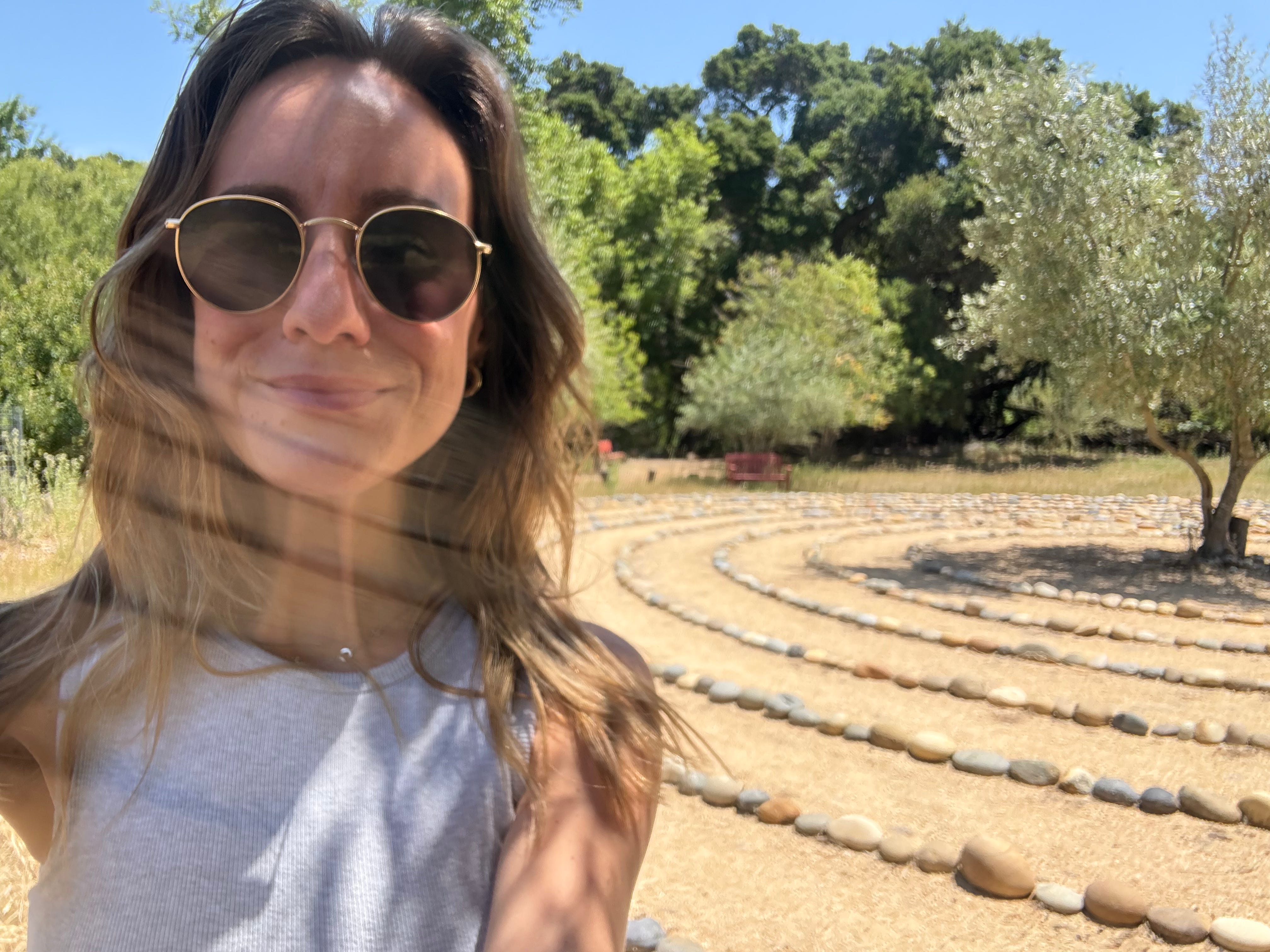
Finally, I’m always on the lookout for a good labyrinth, and The Jesuit Retreat Center at Los Altos did not disappoint (see above). Curious about labyrinths? Re-sharing Michael J O'Connell’s excellent essay here.
Thanks for sharing this really beautiful and real talk, Marissa. (And, as always, shout out to the labyrinth hive — I found a cool one on a trip out to Phoenix a few weeks ago 😀)
Beautifully shared, friend! And omg that icon 🤯😍 love those quiet moments shared from Christ’s early life.